



The Truth Behind The Plot

Updated: Dec 1, 2025

Sometimes, you don’t really understand a book until life teaches you the language it was written in. That’s honestly how I felt rereading Purple Hibiscus as an adult. When I first read it, I just saw a strict father, a quiet girl, a nice aunty, and vibes.
But rereading it? I saw trauma. I saw emotional suffocation disguised as “order.”
I saw a girl who didn’t even know she was carrying anxiety because she thought fear was normal.

How Stories Portray Emotion, Using Purple Hibiscus
Kambili is the perfect example of how authors can show mental health without ever mentioning the words “anxiety” or “trauma.” This girl didn’t cry or shake or have dramatic breakdowns, but you could feel her fear. You could feel how she measured every breath around her father. You could feel how silence was her second skin.
She didn’t even realize something was wrong until she experienced something different.
Aunty Ifeoma’s home was chaotic in the most beautiful way, laughter, arguments, noise, freedom. And the moment Kambili returned home and everything felt “off,” that was trauma speaking. That “heaviness” she felt? That confusion? That sense of shrinking back into herself? Those were emotional cues Adichie used to show how environments affect mental health.
And then there’s Jaja.
His one line, “We’re going to Awka today. We’ll walk even if we have to.”
That was a cry for air. A bold refusal masked as a casual statement. A boy tired of drowning in control. Adichie didn’t need to say “Jaja was depressed” or “Jaja needed freedom.” His actions said it all.
That’s how good fiction works, the emotions are woven subtly. You feel them before you name them.
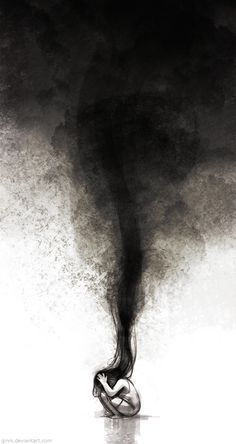
Tropes Around Trauma - The Things We Always See
There are certain patterns that show up again and again when authors write about trauma:
The Quiet Child: like Kambili, like Theo from The Goldfinch. Kids who shrink themselves because noise has consequences.
The Overprotective Perfectionist: characters who try to be flawless so they don’t get hurt. Literally Kambili. Also Lara Jean in To All The Boys I’ve Loved Before, in a softer way.
The “Strong” One Who’s Actually Breaking: characters who act normal until one small moment exposes everything. Think Celie in The Color Purple. And Kambili's mother.
Trauma in fiction isn’t always loud. Many times, it’s the little things, flinching when someone raises their voice, being too careful, staying small, avoiding joy because joy is unfamiliar.

Writing Mental Health Authentically - What Actually Works
Writing mental health well isn’t about making characters cry every page. It’s about the truth. It’s about those tiny details that say, “Someone has lived this.”
Here’s what makes it authentic:
1. Subtle Behaviors:
Not everyone with anxiety shakes or panics. Some people just overthink every text message. Some don’t speak unless spoken to. Some rehearse their smiles.
2. Environment as a Trigger :
Like Kambili feeling lighter at Aunty Ifeoma’s place. Writers who understand mental health know that the environment is half the story.
3. Internal Conflicts:
Characters questioning themselves, feeling guilty for feeling sad, blaming themselves for things beyond their control, that’s real.
4. Growth Isn’t Linear :
Healing in fiction shouldn’t be magical. It should be messy. Two steps forward, one step back.
A good example is Charlie from The Perks of Being a Wallflower. The boy kept trying, failing, restarting, trying again. That’s authentic. That’s how the mind works.

The Clinical Lens
Fiction often captures mental health in ways that feel true long before people have the words for what they’re experiencing but beneath the emotions Annie explores, there are real clinical patterns being reflected sometimes accurately, sometimes not.
Anxiety, for example, is not always panic attacks or trembling hands. Clinically, it often looks exactly like Kambili: hyper-vigilance, quietness, over-compliance, and a body that has learnt to shrink in unsafe environments. Anxiety can be silent, obedient, and invisible. Many authors get this right without naming it.
Anxiety in reality can also involve avoidance due to fear, mental restlessness, physical tension, difficulty sleeping and more commonly, overly thinking.
When it comes to depression, where things that once brought joy now feel empty or exhausting. That crushing feeling of being a burden, or believing nothing will improve.
Depression in fiction is often portrayed as constant sadness. But in reality, it can look like emotional numbness, withdrawal, irritability, hopelessness, fatigue in every sense of the word or a character who simply moves through life on autopilot. Jaja’s flat rebellion, his growing distance, his refusal to pretend, now those are clinically consistent with a mind trying to preserve itself under stress.
PTSD just doesn't come as flashbacks or dramatic breakdowns. Sometimes it’s environmental sensitivity: how a character breathes easier in freedom yet tenses in old spaces. There's hyperactivity of the mind, changes in mood, changes in thinking, suicidal tendencies, unwanted relations and downright shutting down time and time again.
The thing is, trauma is stored in the body, in muscle memory and fiction that highlights behavioral changes rather than dramatic scenes often mirrors real psychology more accurately.
Where fiction becomes harmful is when it equates trauma with strength, or portrays healing as a sudden transformation. All of a sudden the character is fine with a new relationship or one lucky streak, no!
There could be a start, then progress, yet regression, then trying again, failing again, it's all a part of it.
Real wellness is gradual. It’s patterned, not magical.
Accurate portrayals matter because they give readers language and permission to understand themselves. When stories treat mental health with real insights, people finally realize that their quiet wounds are actually valid, and their healing is possible.

Why It Matters
Books teach empathy.
Sometimes the only reason someone finally understands their own emotions is because a fictional character mirrored them first.
When authors portray mental health honestly,
➢people feel seen,
➢people learn compassion,
➢people realize silence isn’t strength,
➢and people know they’re not “dramatic” for feeling how they feel.
Stories can be mirrors.
Stories can be warnings.
Stories can be healing.
And honestly? Some of us didn’t learn the language of our emotions from our parents or even school, we learnt it from books.
To end it all, stories shape how we see ourselves, and when they get it right, they can be the first step toward real wellness so the more we blend emotional truth with clinical clarity, the closer we get to a world where mental health isn’t misunderstood or minimized.
This post is a collaborative piece by JoJo Talks Med (Joanna Lawal) and Anita Marsha (Annie Pearl) — a fusion of clinical insight and literary interpretation.
Our aim is simple: to help readers understand how fiction shapes the way we see mental health, and to create more honest, empathetic conversations around anxiety, depression, trauma, and healing.
If you’d like to reach us
📩 Joanna — @jojo_sparkles25 on Instagram
📩 Annie Pearl — @Anita Marsha on LinkedIn
Thank you for reading, reflecting, and growing with us🌹




I need to read Purple Hibiscus again. And probably watch To all the boys I loved before again. This was awesome, Jojo
Amazing blog!